
Robot Arm State Mapping and Virtual–Physical Synchronization
01
Project Background
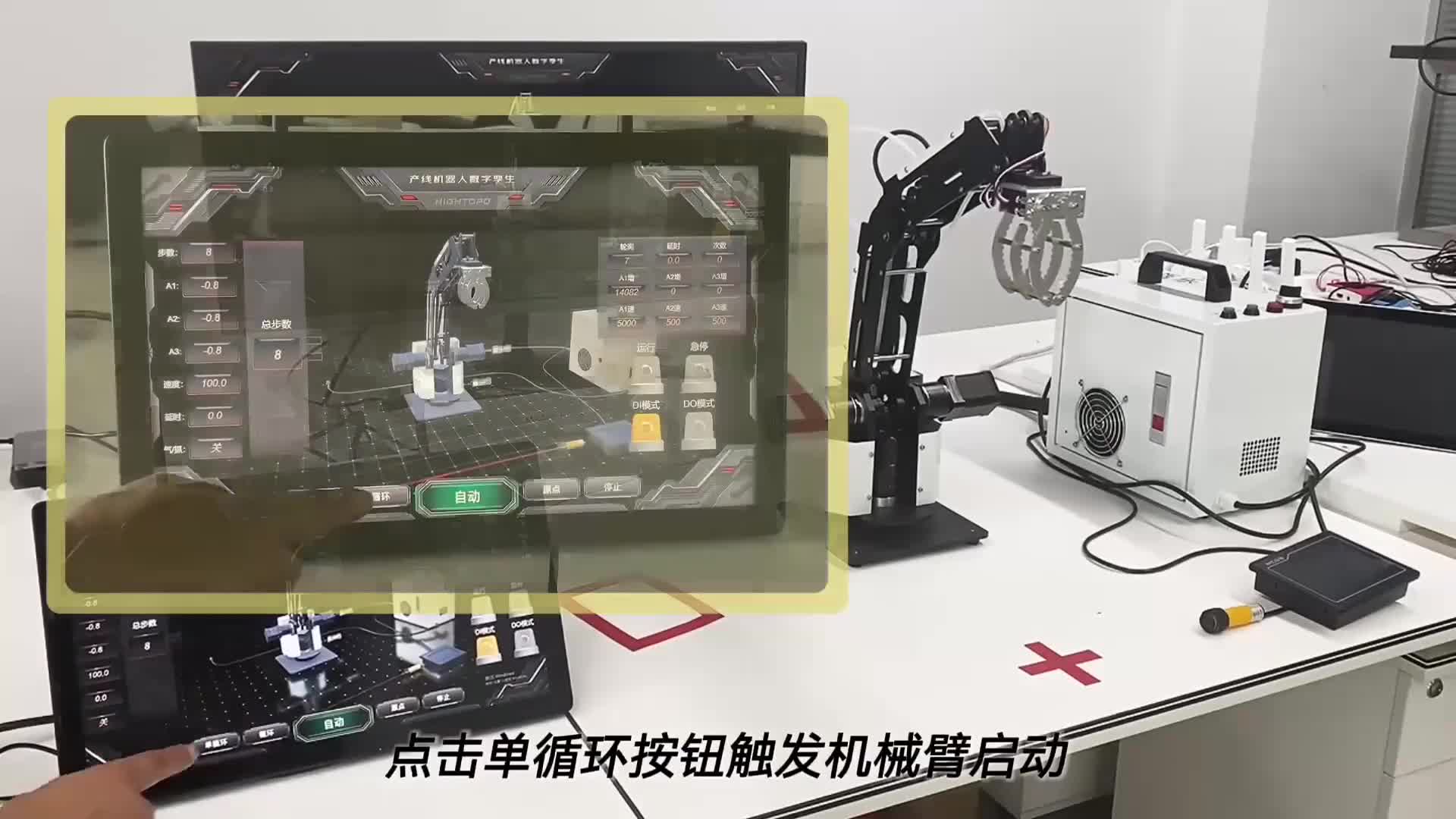
We organize integration testing around linked physical and virtual robot-arm scenarios: establish trustworthy state mapping before addressing control and processes. Demonstration visuals explain the entities and interface; they do not, by themselves, establish synchronization accuracy or completion of all acceptance checks.
02
Technical Approach
Physical-device interfaces, state mapping, and 3D presentation are implemented separately. Each joint has an explicit zero position, positive direction, unit, and timestamp, while tools and workpieces use separate coordinate frames. Command dispatch and confirmed completion are distinct states, preventing playback of preset motion from being mistaken for a real closed loop.

03
Implementation Process
Start with offline trajectory replay to check kinematic consistency, then connect read-only device data. Confirm authorization and on-site safety separately for physical control. Next add gripper, workpiece detection, and operation-step signals, recording disconnections, delays, and recovery while avoiding too many new variables at once.
04
Deliverables
Deliver the robot-arm twin scene, joint and signal mappings, integration testing interface, and fault recovery records. Each item identifies its version, inputs, operating environment, and corresponding acceptance steps.
05
Acceptance Approach
Check state deviations across multiple poses and speeds and record data latency, rather than judging video appearance alone. Hand over device protocols, calibration parameters, and replay examples. The physical system remains responsible for safety interlocks; the twin interface does not bypass on-site controls or emergency stops.
06
Method Recommendation · Consistent State Monitoring and Export
Similar state-mapping demonstrations can add a field dictionary linking objects, variables, units, and time to lists, charts, and export columns. Use controlled teaching data to check object ownership of identically named fields and validity states after pauses, data interruption, and restarts.
Check monitoring independently of robot calibration, motion control and site safety validation. If display sampling and source records are asynchronous, preserve their timestamps and processing rules and compare them over a consistent interval.
07
Implementation Outcomes
Locate mapping and integration issues faster.
Once standardized data mapping is established, joint direction, zero position, limit, and data-update anomalies are easier to identify, reducing repeated troubleshooting through verbal descriptions.
Acceptance compares the time needed to locate similar faults and records timestamps, joint deviations, and reconnection recovery, creating reusable integration assets.