
Which projects fit?
For engineering projects reviewing requirements, interfaces and behavior together, or teams standardizing, exchanging or baselining existing models.
Modeling Outsourcing
New Horizon provides systems architecture, requirements traceability, multiphysics and ontology modeling, delivering model projects, object dictionaries, relationship rules and review records. Choose SysML, UAF/DoDAF, Modelica or ontology models around engineering questions and connect them to knowledge graphs and AI applications.
Last updated: 2026-10-13 · Provider: New Horizon Digital Outsourcing Team
View delivery and acceptance detailsIndex

Deliverables
| Type | Description |
|---|---|
| Phase documentation | Modeling plans, view descriptions, and review-minutes templates |
| Model assets | SysML/UAF/Modelica project files and baseline inventories |
| Custom software | Modeling support tools / export workflows (source code available by agreement) |
| Acceptance materials | Checklists, traceability evidence, and handover inventories |
Our approach to value for money draws on years of project experience and lean team operations: reusing model libraries, scenario templates, and toolchains to reduce duplicated development. Our aspiration is “around 10% of the budget and 30% of the time, aiming for a 100% increase in efficiency.”
Typical deliverables include an accessible model project, key views (requirements/structure/behavior), documentation, and review materials. Integration with an existing toolchain can additionally include export scripts or small custom tools, with source code available by agreement.
Acceptance is based on the completeness of agreed viewpoint products, naming and traceability rules, and records of review approval. Check the required view inventory and traceability matrix at acceptance, rather than only demonstration screenshots.
The scope can include model construction, parameter-calibration support, and integration guidance. Full electromechanical–thermal, rigid-body, fluid, and other simulation verification is covered under Simulation Outsourcing; services can be combined across domains.
Prioritize a tailored viewpoint set, reuse team templates and established project patterns, and establish a reviewable baseline before deepening the model iteratively. This is a key route to value for money.
Define how configuration choices change the model, preserve the complete source model, and check delivery scope and regeneration for each configuration.
Define execution scope, initialization, event inputs, and termination conditions instead of equating animation with behavior verification.
Control domain customization through minimal scope, attribute rules, and validation examples while distinguishing language semantics from tool-specific presentation.
Define exchange scope, object identity, relationship meaning, and round-trip checks instead of treating an opened file as a lossless transfer.
Use headers, field types, and stable identifiers to plan a small trial import, isolate errors, and reconcile results.
Define inspectable engineering-property semantics for types, units, missing values, inherited overrides, and invalidation of derived results.
Build reviewable editing, undo, and save workflows around the distinction between diagram representations, references, and model elements.
Verify the model checking mechanism itself through rule scope, passing and failing examples, execution status, and upgrade review.
Use mapping registers, representative models, and round-trip checks to identify semantic loss, dependency conflicts, and duplicate elements during model conversion.
Build a maintainable collaboration workflow around model ownership, edit permissions, locking, updates, and frozen baselines.
A practical MBSE review workflow covering model completeness, interface consistency, behavior checks, and verification evidence.
Traceability must connect requirement sources, design objects, and verification evidence, rather than simply generating relationship matrices.
Before choosing a graphical representation, interface modeling should establish what the two sides exchange, when they exchange it, and how errors are handled.
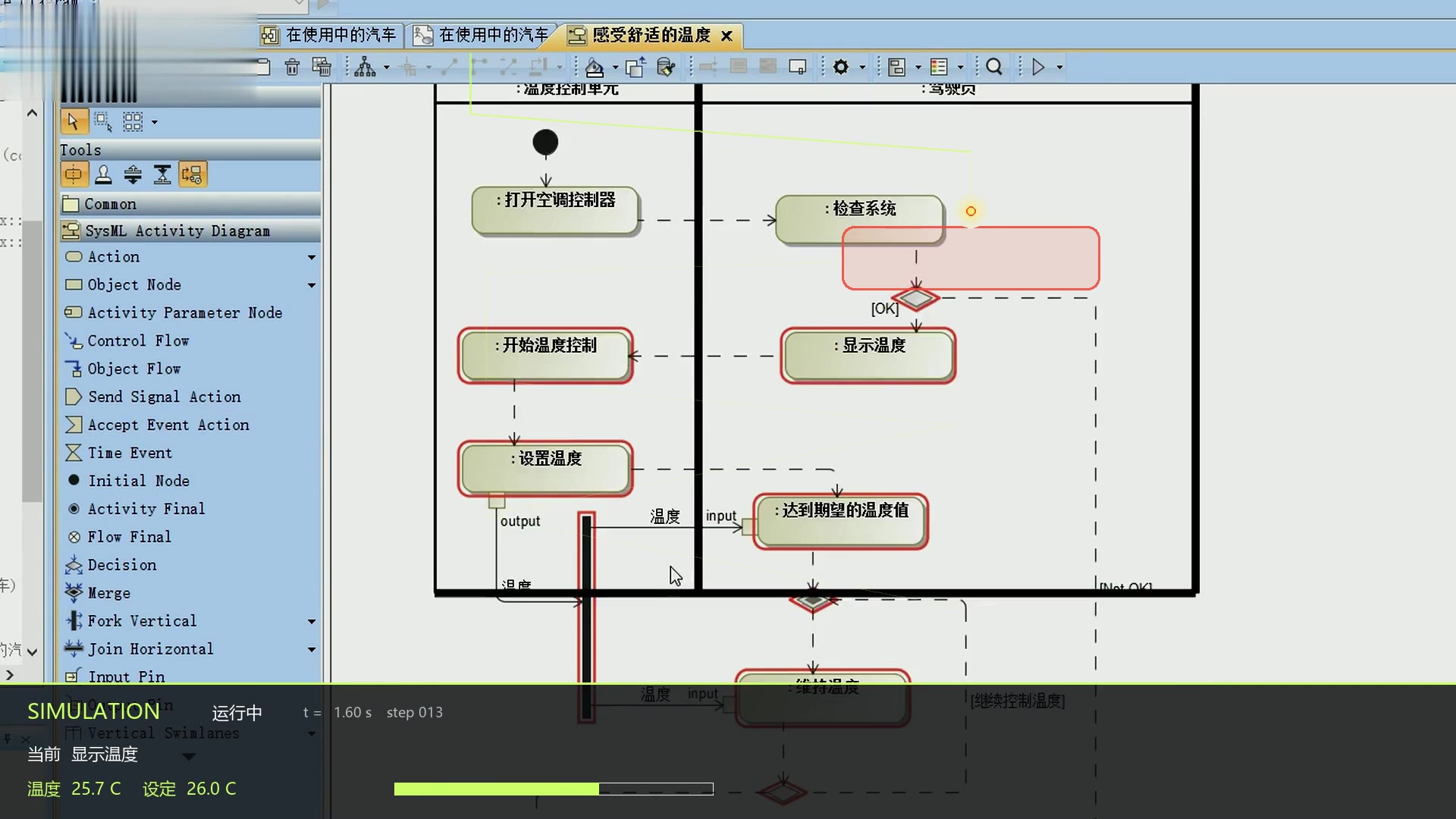
The three representations address different questions: state machines describe modes and transition conditions, activity flows describe work steps and branches, and sequence diagrams describe the order of messages between participants.
Model reuse should rely on controlled components and explicit dependencies, rather than copying a project and renaming its contents in bulk.
Plan the scope of SysML v2 modeling and migration through representative model pilots, tool interoperability, traceability checks, and handover evidence.
Tailor viewpoints around system-of-systems missions, capabilities, resources, and system responsibilities to avoid duplicate diagrams and inconsistent model definitions.
Explain the boundaries between models, FMUs, and solver environments, along with interface, time-step, unit, and reproducibility requirements in co-simulation.
Explain typical deliverables, acceptance criteria, and applicability limits for outsourced SysML modeling to help project teams assess the outsourcing scope.
Other service domains
Engineering delivery brief
For engineering projects reviewing requirements, interfaces and behavior together, or teams standardizing, exchanging or baselining existing models.
Provide mission descriptions, requirement identifiers, system breakdowns, interfaces, existing models and tool versions. Identify who approves requirements and assumptions, and define the review questions for this phase.
Scope depends on input maturity; modeling cannot replace requirements decisions. Structural and behavioral views alone do not establish physical performance without analytical models or test data.
Key drivers are model size, relationship count, language and tool versions, source quality, custom rules and review rounds. Validate one end-to-end trace before expanding.
Acceptance Evidence
Open the project in the recipient tool and check dependencies and missing references.
Acceptance Evidence
Sample critical requirements against responsible elements, interfaces, behavior and verification methods.
Acceptance Evidence
Check closure evidence, remaining assumptions and maintenance ownership.
Related case study
Organize IoT system functions, structure, parameter calculations, and product data into a traceable system model project.
Read the full case studyRelated standards and technical documentation for solution selection and implementation.
Describe your phase objectives and constraints without classified details, and we will provide scope recommendations.