
Spacecraft Telemetry State Mapping and Fault Replay: A Method Case
01
Project Background
Spacecraft state analysis requires component relationships, telemetry semantics and mission time to be understood together. A value change may reflect a mode transition, sampling interval or missing data. Attaching values to a 3D object alone does not tell reviewers which object changed or when.
The source proposes interaction, twin application, twin runtime, data and infrastructure layers, and describes telemetry governance and health-prediction functions. This case develops an engineering method focused on satellite-platform state interpretation and historical review, rather than lunar-rover motion validation or drone-swarm control.

02
State Mapping and Data Governance
First establish component identifiers and a measurement dictionary containing types, units, enumeration meanings, acquisition times and validity conditions, then map measurements to model objects. Label raw measurements, rule-derived states and simulation outputs separately; nearby display fields with the same name are not necessarily the same signal.
Retain raw records and transformation rules so cleaning, calibration and normalization remain traceable. Explicitly mark missing, stale and out-of-order data and document alignment uncertainty. Displays must not conceal interruptions through interpolation or keep presenting the last valid reading as current live state.
03
Proposed Fault-Replay Workflow
Begin implementation with traceable historical logs. Fix the model, mapping rules, initial state and replay interval, then link alerts, state changes and recorded commands to build a reviewable event replay workflow.
Keep acquisition and reception times separate and check state consistency after pausing, seeking and restarting. Replay supports candidate explanations and further checks; event order does not prove causation. Isolate replay operations from real command channels to prevent historical commands from being sent again.
04
Deliverables and Verification
Proposed deliverables include field mappings, quality rules, a model-version manifest, replay configuration and issue records. Acceptance uses known inputs to check objects, units, states and time, including missing fields and discontinuous timestamps. Tolerances must come from mission requirements, not demonstration screens.
The receiving team reconstructs an event from the same log, checks key states and provenance around the anomaly, and records intervals that cannot be reconstructed. Accept software replay consistency separately from physical-model accuracy; metrics lacking real data, calibration records or independent comparison remain unverified. Attach the relevant event and review evidence to each anomaly conclusion, with specialists confirming the interpretation scope so data-quality problems are not mislabeled as equipment faults.
05
Original Interfaces and Application Limits
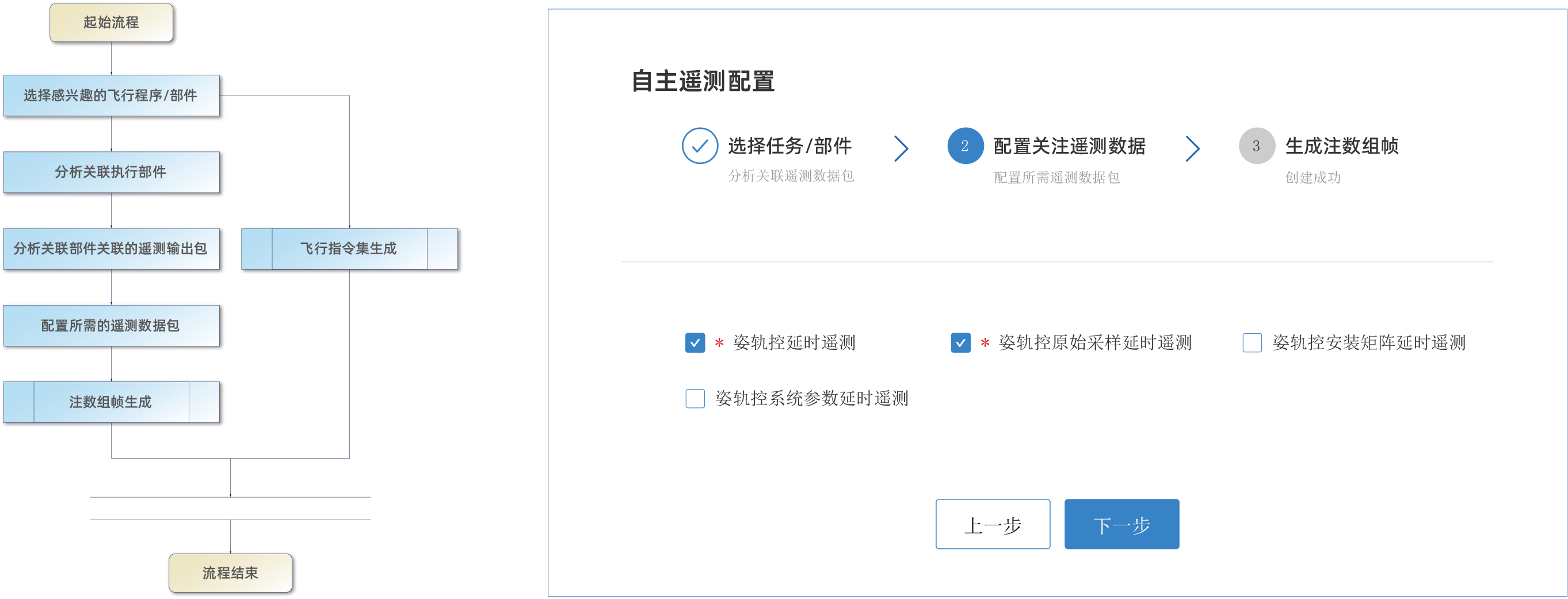
The health prediction interface brings parameters, models and trends into a single analysis workflow; the telemetry wizard organizes setup steps and field selection. Data mapping, time consistency and prediction models require separate validation during integration.
This method case focuses on telemetry configuration, state mapping and event replay design. A real-time state twin requires authorized data, interface and clock checks, and mapping and latency validation. Health prediction needs independent samples and evaluation criteria.
06
Implementation Outcomes
Expected efficiency gains come from shared field semantics, timelines and versions, allowing reviewers to examine one event with consistent evidence and reducing cross-screen reconciliation and repeated explanations. This mechanism is not an achieved operational benefit or proof of automatic root-cause identification.
With logs, event complexity and participant roles held fixed, assess the workflow through event-location time, state traceability and replay consistency, while recording missed detections and incorrect judgments.