
Simulation-Driven Satellite Time-Series AI Design
01
Project Background
Operational anomaly and degradation samples are often scarcer than normal data, and some faults cannot safely be induced on equipment. Parameterized simulation supplies candidate conditions for health trends, anomaly detection and specialized forecasting research.
Simulation coverage depends on models, parameters and fault mechanisms. Record inputs, solver settings, random seeds and validity checks for each run, excluding numerical failures and physically invalid cases from training labels.
02
Technical Approach
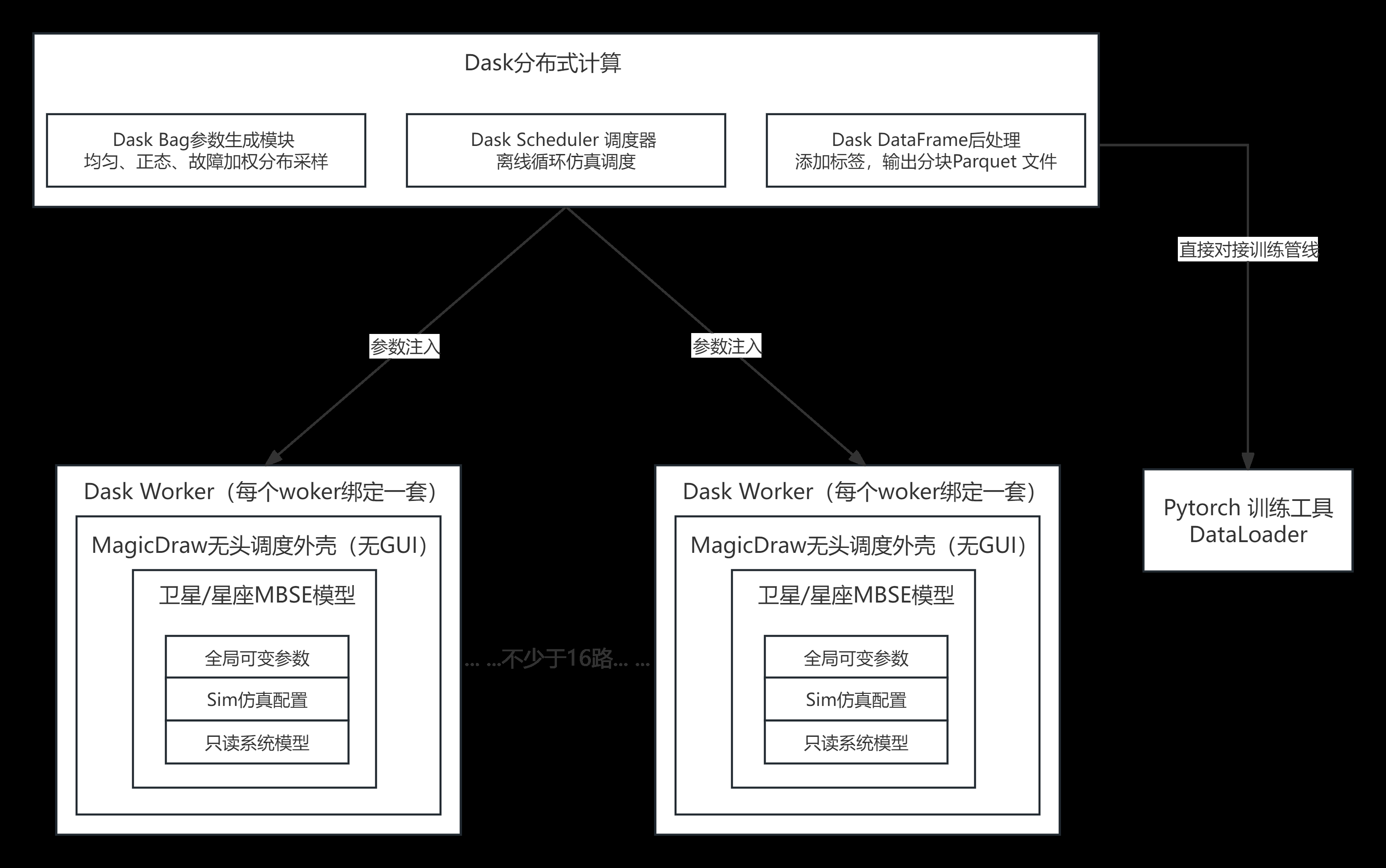
The study proposes distributed scheduling across simulation instances, combining parameter sweeps, fault injection, result checks and dataset registration. Evaluate scheduling alongside tool licensing, concurrency limits and failed-run handling.
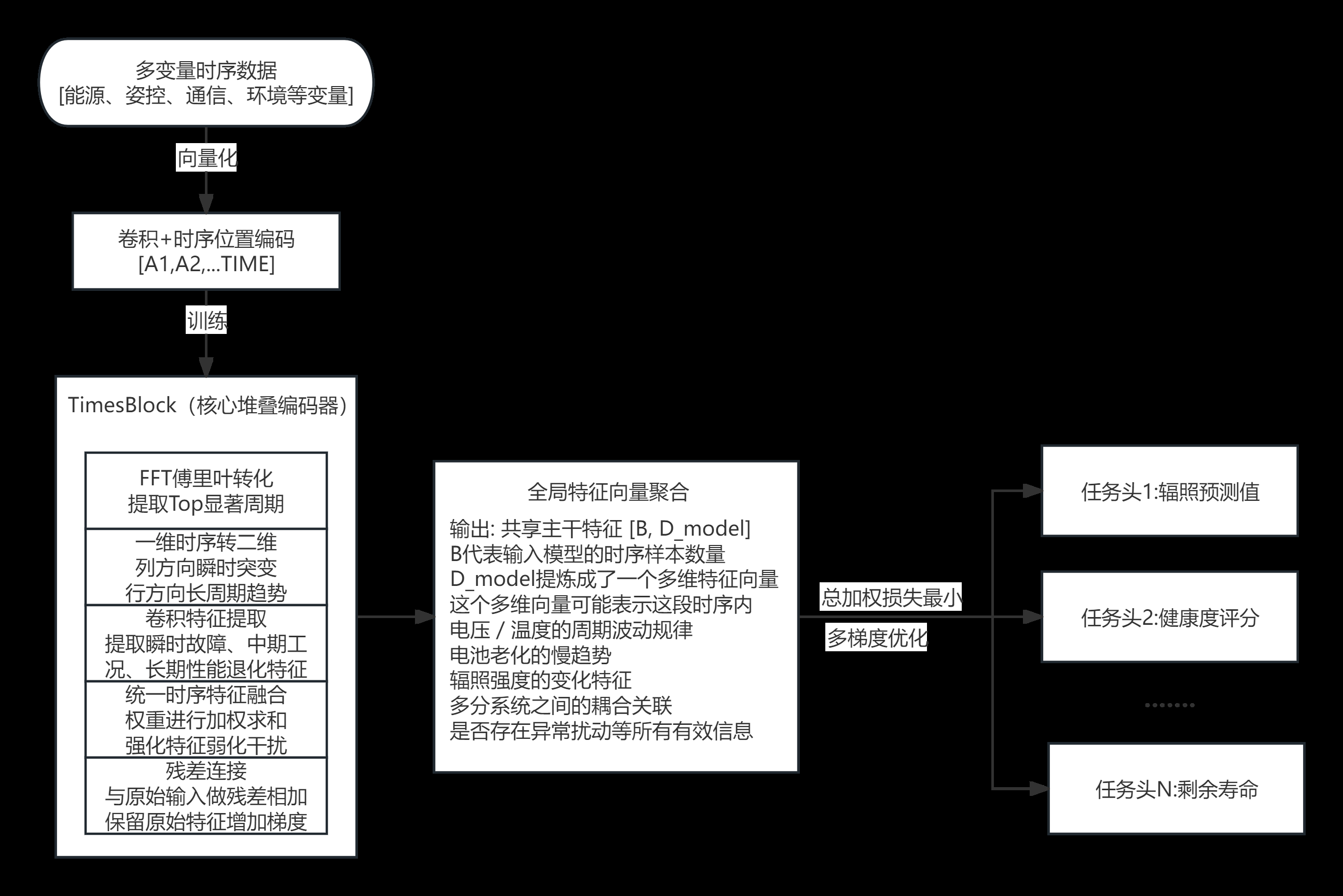
The proposed route combines simulation pretraining and real-data fine-tuning, with time-series methods such as TimesNet as references. Subsystems may use independent models or task heads sharing a backbone, depending on task relatedness and independent validation.
03
Implementation Path
Begin with a small reproducible dataset and training run for one subsystem, then expand concurrency and operating conditions. Separate training and evaluation by equipment, mission or time period to prevent leakage from adjacent time windows.
After inference, check units, operating ranges and applicable conservation or trend constraints. Measure latency, memory, power and error before choosing compression or distillation for edge deployment; parameter count alone does not establish spaceflight suitability.
04
Delivery Scope
Planned outputs include operating-condition matrices, fault definitions, dataset versions and quality records, generation jobs, training configurations and evaluation report templates. Model weights, inference packages and deployment reports follow completed training and target-hardware validation.
05
Acceptance Method
Measure job completion, invalid-sample rates, output per resource and provenance completeness. Evaluate forecast error and interval coverage, or false alarms and missed anomalies, reporting operating conditions and real-data results separately.
Sample volume, concurrency, compression ratios and generation time in the proposal are planning parameters awaiting validation. Benchmark representative conditions on licensed tools and actual hardware before setting a production schedule.
06
Implementation Outcomes
The architecture covers data generation, training workflows and engineering constraints. The next stage connects distributed data generation, then validates sample quality, training reproducibility and prediction performance on independent test data.
A pilot should start with a reproducible small dataset and independent real-data evaluation, establish simulation validity, generalization and resource cost, then expand training and deployment.